Elon Musk told Davos robots will outnumber humans and autonomy is solved, predictions that carry particular weight for the Middle East where governments are staking hundreds of billions on his technologies arriving on schedule.
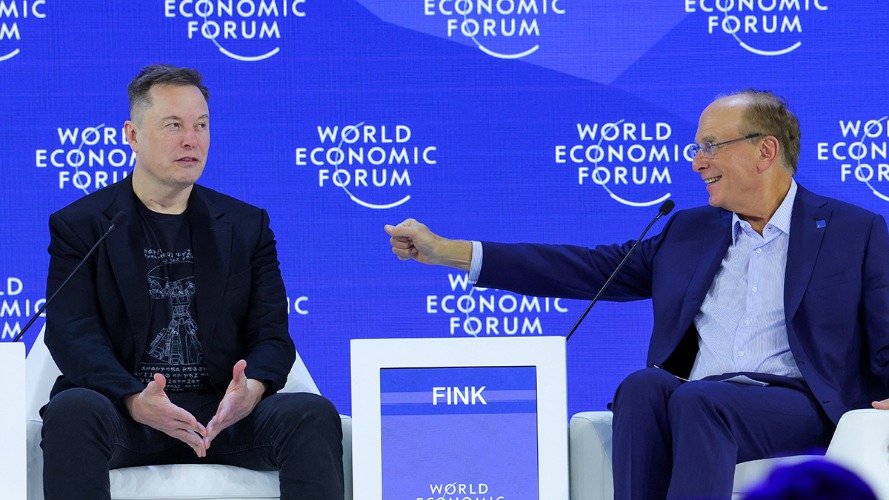
Elon Musk made his first appearance at Davos and came loaded with predictions. Robots will outnumber humans, artificial intelligence will surpass collective human intelligence within five years, and self-driving cars are essentially a solved problem that will become widespread by the end of this year. The world's richest person, who spent years dismissing the World Economic Forum as elitist and boring, appeared on stage with BlackRock CEO Larry Fink on Thursday and painted a sweeping vision of technological abundance powered by ubiquitous AI and humanoid robots. It was vintage Musk, audacious and familiar to anyone tracking his timelines over the past decade, but this time the predictions carry particular weight for the Middle East, where governments are betting hundreds of billions of dollars on the very technologies Musk says are just around the corner.
The appearance was a late addition to the program, slotted in one day after US President Donald Trump addressed attendees. Fink opened by urging the crowd to clap harder for Musk, who kicked off with a joke about Trump's territorial ambitions, referencing a peace summit and quipping about wanting a piece of Greenland and Venezuela. The humor fell flat, but Musk pressed on, outlining a future where AI and robotics deliver abundance, meet all human needs, and transform energy into the only real bottleneck. He predicted AI would become smarter than any individual human by the end of 2026 or early 2027, and within five years could surpass the collective intelligence of humanity. He described a world where humanoid robots like Tesla's Optimus would handle tasks from factory work to elder care, eventually outnumbering people.
Tesla's Optimus robots are currently performing simple factory tasks and Musk said they would handle more complex industrial work by year's end, with public sales potentially beginning by late 2027 once reliability and safety were proven. The humanoid robotics market is currently valued at between $2 billion and $3 billion, according to Barclays analysts cited by CBS News, but Musk's vision is that these machines will eventually saturate all human needs to the point where people will struggle to think of tasks to ask them to perform. On autonomous driving, Musk declared the problem essentially solved, claiming Tesla has rolled out robotaxi services in a handful of US cities and expects them to be very widespread by year's end. He added that Tesla hopes to receive European approval for self-driving vehicles next month, though he did not specify countries.
The confident performance raised eyebrows among those familiar with Musk's decade-long pattern of unfulfilled promises on autonomy. Musk has been predicting fully autonomous Tesla vehicles since 2015, when he called self-driving a solved problem. In 2016, he claimed Tesla would demonstrate full autonomy from Los Angeles to New York by the following year and that all Teslas would become robotaxis by 2020. In 2018, he updated the timeline to three to six months. In 2019, he predicted mainstream autonomous cars within five years. In 2020, he expressed extreme confidence in achieving Level 5 autonomy. In 2021, he claimed Tesla would have over one million robotaxis by year's end. The pattern continued through 2023, 2024, and 2025, with promises of unsupervised Full Self-Driving in Texas and California that never materialized on schedule, according to a detailed timeline compiled on Wikipedia.
As of early 2026, Tesla's robotaxi fleet in Austin consists of around 30 vehicles, most of which are not operational most of the time and still require safety monitors, according to InsideEVs. The service launched in Austin in June 2025 with human safety operators in the passenger seat, far from the autonomous deployment Musk promised. Wait times in downtown Austin have been reported at 15 minutes or longer, and the fleet has not expanded to the eight to 10 major metro areas Musk claimed it would reach by the end of 2025. Tesla's Full Self-Driving software remains classified as Level 2 automation, meaning it requires human oversight and is far from the hands-off autonomy Musk has been promising since 2017.
The gap between Musk's predictions and delivery timelines matters particularly in the Middle East, where Tesla is expanding aggressively and where governments are pouring unprecedented sums into AI, robotics, and autonomous vehicle infrastructure based on similar assumptions about technology readiness. Tesla opened its first showroom and service center in Riyadh in April 2025, according to Rest of World, finally entering Saudi Arabia after years of anticipation. The company launched with Model 3, Model Y, and Cybertruck offerings, alongside pop-up stores in Jeddah and Dammam, and plans to roll out a Supercharger network accessible to other EV brands.
Tesla's entry comes as Saudi Arabia targets 30 percent EV adoption by 2030, a steep climb from just over 1 percent penetration in 2024, according to PwC data. To support this goal, Saudi Arabia is investing an estimated $39 billion in its EV sector, fostering domestic manufacturing through ventures like Ceer, a joint project between the Public Investment Fund and Foxconn that aims to produce 500,000 EVs annually by 2030. Despite these ambitions, infrastructure lags significantly. Saudi Arabia had only around 104 charging stations nationwide in 2024, compared to over 260 in the UAE, which has one-third the population. The kingdom's extreme heat, with summer temperatures exceeding 50 degrees Celsius, poses challenges for battery performance and vehicle range that Tesla will need to address.
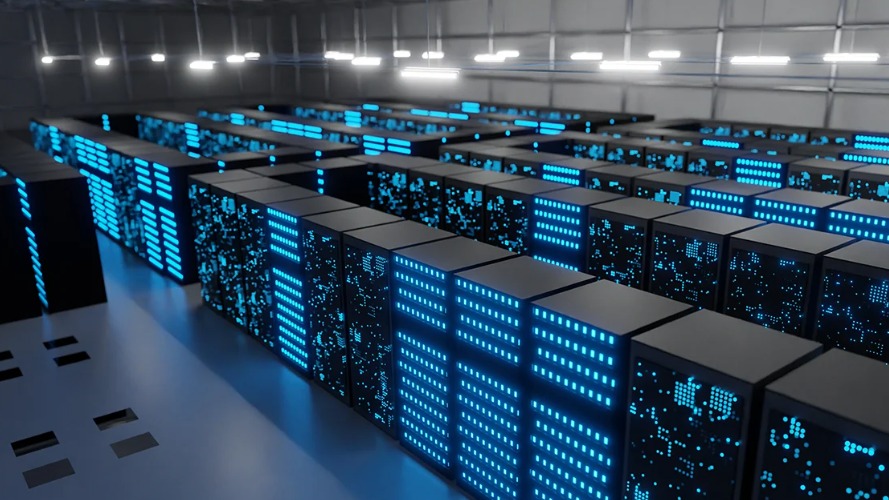
The broader AI and robotics vision Musk outlined at Davos aligns directly with the Gulf's economic diversification strategies, but the region is discovering that building an AI ecosystem requires more than capital. Saudi Arabia and the UAE are engaged in a high-stakes race to become the Middle East's dominant AI hub, with both countries committing massive sums to data centers, compute infrastructure, and partnerships with US tech giants. Saudi Arabia has announced a $10 billion AI hub with Google Cloud, a $5 billion AI zone with Amazon Web Services, and a $14 billion Oracle investment over 10 years. The kingdom's Humain, a state-backed AI company under the PIF, is planning a $10 billion venture capital fund. The UAE launched MGX, an investment firm backed by Mubadala and G42, aiming to invest $100 billion in AI infrastructure, chips, and core technologies. MGX is among the investors in Stargate, OpenAI's $500 billion data center project.
AI is expected to contribute approximately $320 billion to the Middle East's economy by 2030, representing roughly 11 percent of the region's GDP, according to PwC analysis. In absolute terms, Saudi Arabia is projected to capture over $135 billion of that total, equivalent to 12.4 percent of GDP, while the UAE is expected to see the largest relative impact at close to 14 percent of GDP. The UAE appointed the world's first minister of AI in 2017 and has methodically built capabilities through initiatives like the Mohamed bin Zayed University of Artificial Intelligence and Dubai Future Foundation. Saudi Arabia is building AI capabilities through megaprojects like Neom and its newly unveiled AI entity Humain, with partnerships including Nvidia's commitment to build 500 megawatts of AI factories powered by hundreds of thousands of graphics processing units.
The region's AI ambitions extend beyond the Gulf. Pakistan, which has seen growing interest in digital infrastructure investment, faces challenges including energy constraints and limited access to capital compared to its Gulf neighbors, though initiatives like the National AI Policy Framework aim to position the country as a regional tech services hub. Turkey has been more aggressive, with President Recep Tayyip Erdogan announcing a national AI strategy backed by incentives for domestic chip production and data center development. Khazna Data Centers from the UAE invested $150 million in Turkey to expand regional access to compute power, signaling growing connectivity between Gulf capital and broader MENA markets.
Musk's predictions about energy constraints carry particular relevance for the region. He told the Davos audience that electricity supply, not chip production, is now the limiting factor for AI deployment. He said power generation growth in many countries is far slower than the expansion of computing capacity, and that China is an exception due to its scale in solar manufacturing and deployment. Musk claimed an area roughly 100 miles by 100 miles of solar panels could power the entire United States, and criticized high US tariffs on solar panels, arguing they distort economics because China produces most of the world's supply. He said teams at SpaceX and Tesla are each working toward building up to 100 gigawatts a year of solar manufacturing capacity in the US.
The Middle East has abundant solar potential and access to cheap energy, which positions it well for power-intensive AI infrastructure, but execution remains the challenge. Saudi Arabia is building future data center capacity of approximately 2,200 megawatts compared to the UAE's 500 megawatts, according to industry analysis, positioning the kingdom for long-term infrastructure dominance if projects deliver on schedule. However, the region's track record on megaprojects has been mixed, and data centers require not just energy but also cooling, water, skilled labor, and regulatory frameworks that remain in development.
The gap between Musk's vision and reality matters because governments across the region are making investment decisions based on similar assumptions about technology timelines. If autonomous vehicles arrive years later than promised, EV infrastructure investments may sit underutilized. If humanoid robots take longer to achieve reliability and cost-effectiveness than Musk suggests, industrial automation strategies built around those timelines will need adjustment. If AI capabilities plateau before reaching the transformative levels Musk describes, the economic returns on hundreds of billions in data center and compute investments may fall short of projections.
Musk closed his Davos appearance with a philosophical note, encouraging the audience to be optimistic and excited about the future, arguing that it is better to err on the side of optimism and be wrong than to be a pessimist and right. The sentiment resonates with Gulf leaders who have staked their economic futures on technology-driven diversification. The Middle East has the capital, the energy, and the political will to build AI and robotics infrastructure at scale. Whether Musk's predictions arrive on schedule or follow the pattern of the past decade, the region has already committed to the bet.